~20 min → <4 s
Per-PDF review time
Illustrative POC/MVP reference: manual review versus local-GPU assisted processing.
Case study
An illustrative design-partner narrative for the Ivertiq Full-Stack AI Harness: LC–MS / LC–MS/MS instrument PDFs, sovereign on-prem execution, and human experts on every ambiguous or conflicting case. Not a guarantee of results in every lab.
Illustrative POC/MVP reference: manual review versus local-GPU assisted processing.
Reference scale on workstation-class dual-GPU hardware for monthly-style processing loads.
Forensic evidence, Lab IDs, and chemical results stay inside the customer environment.
Metrics are illustrative POC/MVP selling aids pending validation under each customer’s SOP, QA protocol, input formats, and hardware.
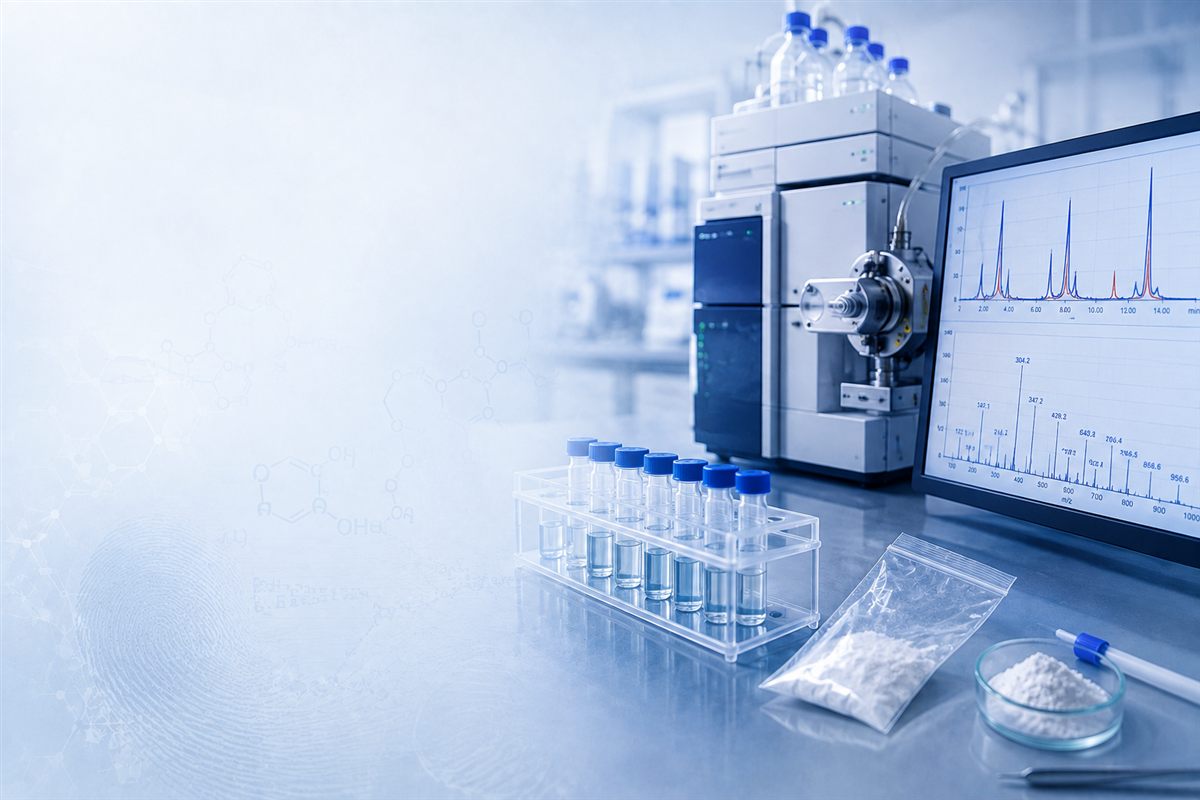
In forensic drug analysis, LC–MS and LC–MS/MS (and in some workflows GC–MS) are the analytical gold standard: liquid or gas chromatography separates a complex sample into ingredients; mass spectrometry characterizes each ingredient and compares its spectrum against reference databases.
Even so, the instrument does not issue a finished judgment. For each ingredient it typically emits a measured spectrum plus database candidates — often HIT 1 and HIT 2 from two libraries — with similarity / confidence scores. Those scores are useful starting points, not sign-off. High-confidence candidates can still be wrong or ambiguous when peak patterns, impurities, noise, or retention-time context disagree. Labs therefore require expert visual inspection of the equipment-generated PDFs before findings are recorded and reported.
As volume rises (thousands of PDFs per month in some settings; tens of thousands of samples per year), adding headcount alone does not scale. Fatigue increases QC risk. Sensitive evidence, Lab IDs, and chemical results cannot be casually uploaded to public cloud AI.
An illustrative forensic LC-MS proof walkthrough from one customer’s POC/MVP. Not a general production guarantee. Timing and hardware figures remain POC/MVP references pending each lab’s SOP, QA protocol, and hardware.
Instrument PDFs / exports and controlled mapping references.
Lab ID, HIT 1 / HIT 2 candidates, similarity cues, and spectrum-linked evidence → controlled drug mapping rules.
Consistent mapping → structured output; conflict, close HITs, or low-quality spectra → expert review.
Optional PPT assembly from LIMS export + selected sample photos.
The same stack pattern that matters here — local execution, structured evidence, deterministic conflict gates, and HITL — is why generic public-cloud copilots are the wrong default for forensic PDFs.
Questions specific to this proof case. Company, partner, and investor FAQs stay on the FAQ page.
It assists review of large volumes of LC–MS / LC–MS/MS instrument reports in forensic drug-analysis laboratories. It does not replace the laboratory’s SOP or the expert who signs out the case.
Instrument-output PDFs containing chromatograms, mass spectra, retention times, library hits, and related analytical evidence.
Analysts must interpret several evidence types together — peak patterns, retention time, signal quality, and database matches — before a finding is recorded.
No. Assist, not autopilot. The Harness helps read the PDF and surface conflicts. Uncertain or ambiguous findings go to a qualified reviewer. Accountable sign-out stays with a designated person.
It evaluates database candidates together with peak coverage, retention-time consistency, noise or interference, and agreement between chart evidence and reported hits. A similarity score alone is not sign-off.
Different libraries, reference spectra, matching algorithms, instrument settings, and sample interference can produce different rankings for the same sample.
The system flags cases with close candidates, missing peaks, high noise, weak hit agreement, or unusual retention times for expert review. It does not guess-merge or pick a “closest” substance.
Yes. The workflow is designed to assess interference, background noise, and overlapping peaks rather than relying on a single similarity score.
Yes. Each recommendation includes structured evidence and metrics that link back to the relevant source-report pages, diagrams, and extracted data.
Core evidence stays in a customer-approved environment — on-prem Node/Station or siloed private cloud. Sensitive reports and identifiers are not sent to public LLM APIs. Air-gap is a real path where the site requires it.
It keeps a reconstructable trail: evidence, scores, actions, and review outcomes for each result — attributable to a model, recipe, skill, or named person.
A designated person remains accountable. They can verify, correct, or approve before a result is finalized. Nothing of legal or scientific effect writes until that explicit yes.
In the illustrated proof of concept, average assist time fell from roughly 20 minutes per PDF to about four seconds per PDF. Actual performance depends on workflow, hardware, and validation. It is not a guarantee for every lab.
Capacity scales with local compute. Larger batches can run on customer-approved hardware. Staffing and sign-out remain the laboratory’s SOP decision — we do not claim a headcount replacement figure.
Forensic LC–MS / LC–MS/MS PDF review is the current proof. The same method may transfer to other regulated lab document workflows when the SOP, HITL gate, and system of record are named. Clinical chemistry, environmental testing, and food safety are discoveries — not live modules.
Local or private-cloud deployment, deterministic workflow steps, domain-specific validation, human-review gates, and audit logging. It is not a chat overlay on a public LLM API.